
How to Build a Realistic Wedding Budget (and Actually Stick to It)
Almost every wedding budget starts the same way: a single round number said out loud, no breakdown, and a quiet confidence that you'll "keep an eye on it." Three months later the number has moved and no one can say exactly where. The problem isn't discipline. It's that a budget without line items and a tracking system isn't a budget — it's a wish.
Start from your number, then divide it
Decide the total you're genuinely willing to spend — the amount that won't create debt or resentment. Then split it into categories before you talk to a single vendor. A common rough split:
- Venue & catering: 40–50%. This is the big one, and it scales directly with guest count.
- Photography & video: 10–15%.
- Attire & beauty: 8–10%.
- Flowers & decor: 8–10%.
- Music / entertainment: 5–10%.
- Stationery, favours, transport, officiant, cake: 5–10% combined.
- Contingency: 5–10%, untouched until the final month. You will need it.
These are starting points, not rules. If photography matters more to you than flowers, move the money — deliberately, on paper, not by accident later.
Guest count is the lever that moves everything
Nearly every per-head cost — catering, bar, rentals, favours, invitations, cake — multiplies by your guest list. Cutting 20 people often saves more than renegotiating three vendors. Build your list first, in tiers (must-invite, want-to-invite, if-budget-allows), and let the budget tell you where the line falls.
Track estimated vs. actual, not just actual
The single habit that keeps a wedding budget honest: for every line item, record what you expected to pay and what you actually committed to. The gap between those two columns is where weddings go over. A vendor comes in $400 high; you absorb it without noticing; that happens six more times; suddenly you're $3,000 over and it feels like it came from nowhere. It came from those six moments.
When you can see the running difference, you catch the drift while it's still small — and you can consciously trade: "the photographer went over, so the flowers come down."
Put deposits and due dates in the same place
Wedding costs don't arrive as one bill. They arrive as a scatter of deposits, second payments, and final balances over 12–18 months. Track each payment with its due date so nothing surprises you and you can see your cash flow month by month.
Where a planning tool fits
You can run all of this in a spreadsheet. A purpose-built tool just does the arithmetic for you: a live budget that updates as you enter costs, an estimated-vs-actual view, a guest list that feeds the headcount math, and payment tracking with dates — all in one place, offline, so your planning isn't tied to a subscription or a login. That's what the Swervve Wedding Planner is.

The Swervve Wedding Planner App
An offline, interactive wedding-planning app — live budget tracker, guest list & RSVP, drag-and-drop seating, day-of timeline. Runs in any desktop browser, no subscription, no account.
View the planner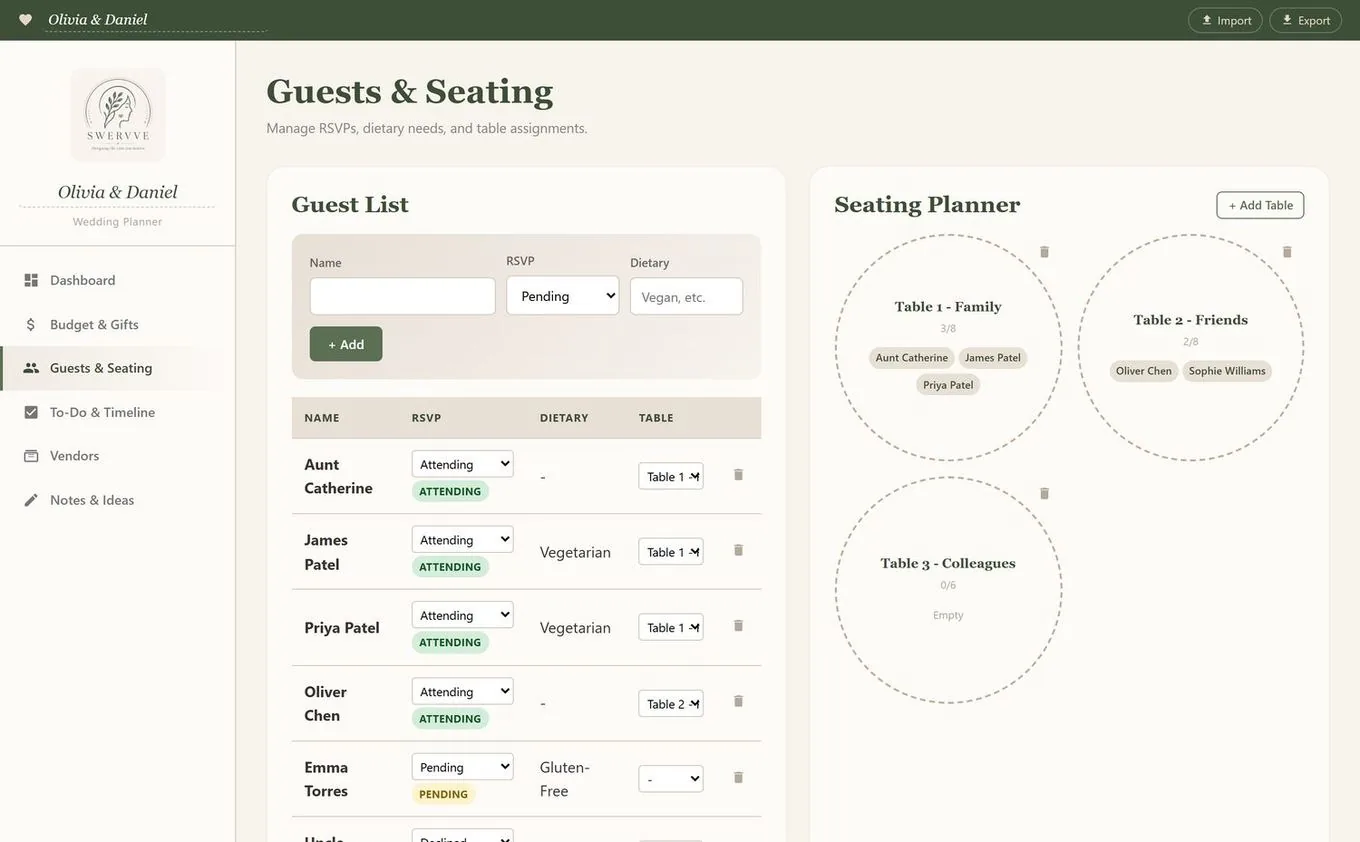
Wedding Seating Chart Etiquette: The Genuinely Hard Cases
Most of a seating chart takes an hour. It's the divorced parents, the plus-ones nobody knows, the work friends and the kids table that take a week. Here's how to handle each one without a family incident.
Nobody Built a Planner for the Feelings Side of Your Wedding
Budget trackers and seating charts handle the logistics. Nothing handles decision fatigue, family pressure, or the quiet feeling that you're supposed to be happier than you are. Here's what actually helps.

How to Stop Overthinking: A CBT-Informed Approach That Isn't "Just Relax"
Overthinking isn't a focus problem you can will your way out of. Here's why the loop keeps running, and a structured way to interrupt it that doesn't rely on positive thinking.