
The Sunday Scaries Are Real — Here's What Actually Helps
It's 6pm on Sunday. The weekend has gone quiet, and your chest has gone tight. You've checked Monday's calendar twice already, even though nothing on it has changed since the last time. That's the Sunday scaries — and it isn't really about Sunday.
Your brain is filling a quiet moment with a preview
When the noise of the weekend stops, your mind finally has room to think about the week ahead — and it thinks about the worst parts first. An unplanned Monday reads to your nervous system as uncertainty, and uncertainty reads as danger. That's the entire mechanism. It isn't proof you hate your job, or that something is wrong with you. It's a very old alarm system, doing its job on the wrong target.
This is why people who genuinely like their work still get the Sunday scaries. The trigger isn't the work itself — it's the blank, unplanned space where your mind is free to fill in the worst case. Give that space a plan, and most of the alarm quiets down on its own.
Why "just relax" doesn't work
Telling yourself to stop worrying rarely works, because the dread isn't really an argument you can win — it's your body pre-loading for a threat it can't locate yet. Trying to reason your way out of it usually just adds a second layer: now you're anxious about being anxious. What actually works is smaller and more mechanical: give the evening a short, repeatable structure, so there's less room for the spiral to run.
A five-minute version you can run tonight
You don't need a workbook to start. Try this on any Sunday evening — or the night before any hard week:
- Catch it. Notice the dread is here before it runs the whole evening. Name it in one sentence: "there's the Sunday feeling." That's the whole first step — just noticing.
- Name one real win. Your mind will skip straight past the week that actually went fine unless you make it stop. Pick one concrete thing that went right, however small.
- Empty the list. Write down everything on your mind about the week ahead — meetings, errands, the email you're avoiding — in any order. The point is getting it out of your head, not organising it.
- Pick one first task. From that list, choose ONE small, specific thing to do first tomorrow. Not the whole week. One task, decided in advance, so there's no decision left to make when you sit down.
- Close the evening on purpose. A screen curfew, tea, laying out tomorrow's clothes — something small that tells your body it's allowed to stop for the night.
That's most of what a structured ritual does: it interrupts the spiral early, before momentum takes over. Once the dread has been running for an hour, it's harder to catch — the win is catching it in the first few minutes.
The part most people skip: looking back
Step two is the one people leave out, and it's doing more work than it looks like. Left alone, most people's memory of "how the week went" skews harder than the week actually was — that's negativity bias, not a flaw in you, just standard-issue wiring. Writing down one specific thing that went right is a small, deliberate correction. It won't erase the dread, but it stops the mental scoreboard from reading 0–10 against you every single week.
Why the blank first task matters so much
The scariest part of Monday is rarely the whole week — it's the undecided first hour. An open-ended "figure out Monday when I get there" leaves a decision sitting there for your dread to negotiate with, all evening. Deciding one small, concrete first move in advance — a specific task, a specific time — removes that decision from the moment you actually have to act. It's a small thing. It's also most of the relief.
Why this works better as a ritual than a read
Anticipatory dread is a weekly pattern, not a one-off crisis, which is exactly why a book you read once won't out-argue a feeling that returns every seven days. A short, repeatable ritual will — not because it's more convincing, but because you actually do it again next Sunday, and the Sunday after that.
If it's more than Sunday-shaped
This kind of ritual is built for the specific, weekly dread of the week ahead — not for anxiety that shows up most days, keeps you from sleeping for weeks at a time, or comes with a low mood that doesn't lift. That's a bigger pattern than any Sunday-evening routine is meant to hold, and it's worth talking to a licensed therapist about. If you're in crisis, in the US and Canada you can call or text 988; in the UK and Ireland, Samaritans is free on 116 123, any time.
Where the workbook fits
The five steps above are the whole ritual — free, right now, no download required. What the printable version adds is repetition made easy: a dedicated worksheet for the routine (plus blank copies for a month of Sundays), a wind-down checklist, cut-out Monday-morning prep cards, and two trackers that turn "I think it's always the Monday stand-up" into an actual pattern you can see in eight weeks of data. If Sunday evenings are a recurring thing for you rather than a one-off, that's the difference between doing this once and actually building the habit.
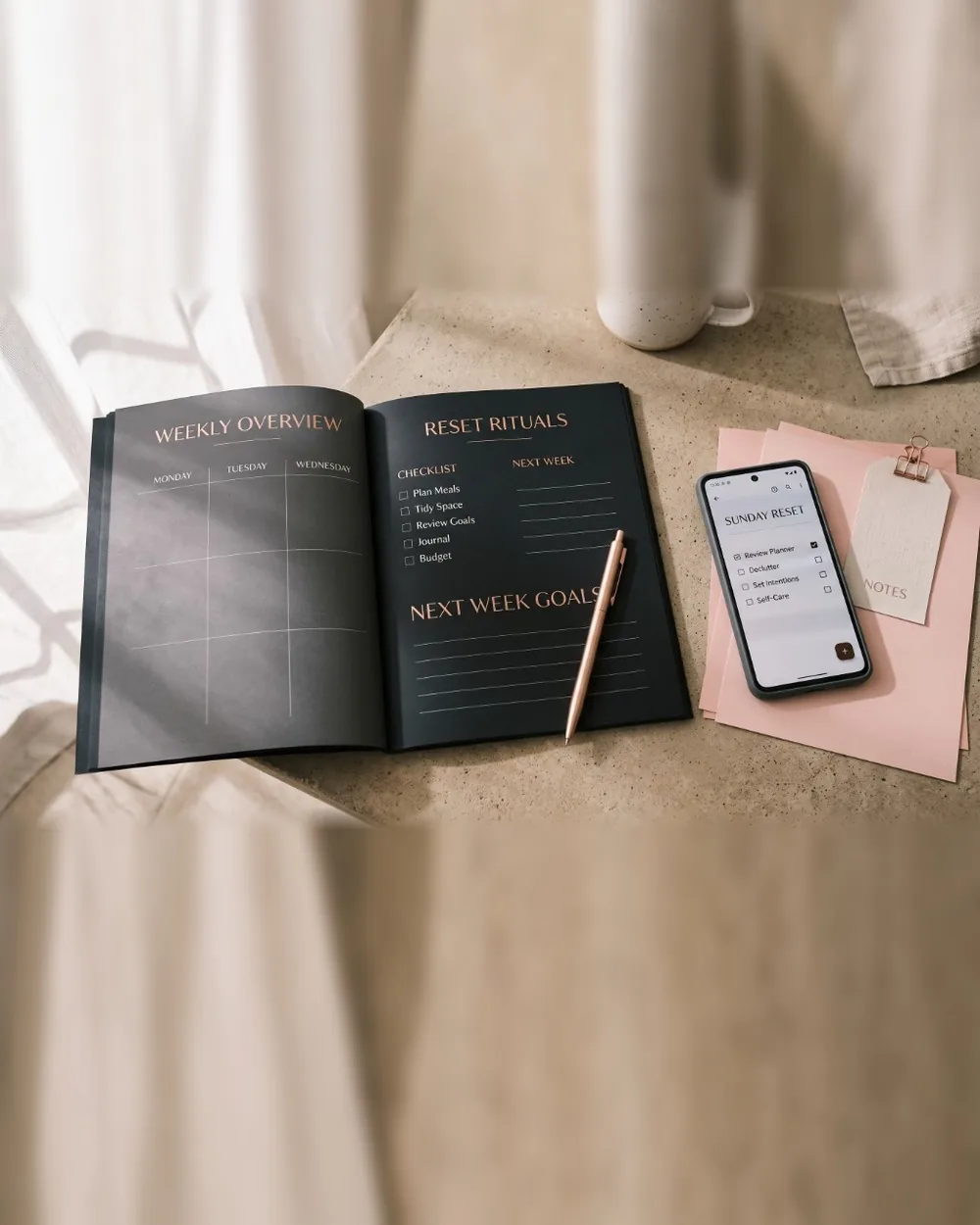
The Sunday Scaries Workbook
A calm, ten-minute printable ritual built around the CLOSE Method — for the dread that shows up as Sunday evening ends. 27 pages, run it every week. Instant PDF & GoodNotes download.
View the workbook
High-Functioning Anxiety: Why "Coping" Isn't the Same as Being Okay
High-functioning anxiety hides behind competence and a full calendar. Here's what it actually looks like, why it's easy to miss, and a simple method for working with it.

How to Stop Overthinking: A CBT-Informed Approach That Isn't "Just Relax"
Overthinking isn't a focus problem you can will your way out of. Here's why the loop keeps running, and a structured way to interrupt it that doesn't rely on positive thinking.

How I Regulated My Nervous System (What Actually Worked)
A first-person account of what it actually took to get out of a wired, braced, can't-settle state — and the handful of things that made a real difference.