
"I'm Not Mad, I'm Full" — Needing Space Without It Meaning You Don't Care
Nothing bad happened today. You were available to people from seven in the morning, you answered everything that was asked of you, and you got home. And then, within about ten minutes, the television is unbearable, the light in the kitchen is too bright, and a completely ordinary question — what do you want for dinner — lands like somebody asking you to move house.
Someone you love notices, and asks the reasonable thing: are you mad at me? And you are not. You are full. But explaining that costs energy you do not have, so you say "I'm fine" — the least convincing sentence in the English language — and the evening gets worse from there.
The argument is never actually about dinner
The reason this keeps happening, and keeps being confusing afterwards, is that load is cumulative and invisible. Attention, patience, tolerance for noise and the ability to compose a sentence all draw on the same pool, and the pool is finite each day. Most of it goes on things that do not feel like work: an open-plan office, three group chats, being the person others come to, making eleven small decisions since six o'clock.
So by the time a genuinely ordinary question arrives, it is not landing in an empty container. It is the last thing in. And because it is the last thing in, it is the only part either of you can see — which is why the post-mortem never makes sense. You both go looking for the cause in something far too small to explain the size of the reaction, and the four things underneath it never get mentioned, often not even to yourself.
Language goes first, which is the cruel part
There is an order to how this arrives, and it is worth knowing yours. For most people it starts in the body — jaw, shoulders, a hand that will not unclench. Then sound stops being background: the TV, chewing, a tap. Then small requests start reading as demands, not because they are unreasonable but because there is nothing left to pay for them with.
And then language goes. Composing a sentence is expensive, so your answers shrink before you have decided to shorten them. This is the genuinely unfair part of the whole pattern: the ability to explain what is happening disappears at almost exactly the moment it becomes necessary. The one thing that would fix the evening is the one thing you can no longer afford.
The uncomfortable page: shutdown and stonewalling look identical
A shutdown is what happens when the system runs out. Stonewalling is refusing to engage — going silent because silence is effective, or because the other person can sit in it for a while. These are genuinely different things, and here is the part that is not flattering: from the other side of the room, they are the same behaviour.
Your partner cannot see your nervous system. They can see a closed face and no answer. They have no way to tell which one it is unless you tell them — and if this has been going on for years, you have almost certainly done both. There is a test for it, and it is not comfortable: if the silence would end the moment they apologised, it was not a shutdown. Worth knowing about yourself, not to feel bad about, but because the two need completely different sentences.
"I need space" is usually the wrong words
Space is a container word. It is what you reach for when you have no capacity left to identify the real thing — and it is also, unfortunately, the single phrase most likely to be heard as from you rather than from all of this.
Nine times out of ten the accurate answer is more specific and far less frightening to hear. Quiet, not solitude — you can sit in the same room in silence. To not be asked anything for half an hour; company is fine, decisions are not. Food, because an unembarrassing number of these evenings are a blood-sugar problem. Sleep, or just knowing sleep is close and nothing else is required first. To not be perceived — no eye contact, no face to hold.
"I need space" asks the other person to leave. "I need twenty minutes where nobody needs a decision from me" asks them for something they can actually give you — and tells them they are not the problem without you having to say so.
The one thing that changes everything: name the return
If you take one idea from this article, take this one. Compare two versions of the same forty minutes.
The first: "I need a minute." True, reasonable, and the shortest sentence available when you have nothing left. But the person in the other room now has no end to aim at, so their only options are to wait without information or to come and find out — which is the exact thing that will make your next forty minutes worse.
The second: "I need forty minutes. I'll come and find you at nine." Same amount of space. About six more words. Completely different evening.
What frightens the person left behind is not the distance. It is not knowing where it ends. A stated return is not a courtesy — it is the thing that stops them following you. John Gottman’s couples research has been specific about this for decades: a break helps when it is announced and has an end, and an unannounced one is read as abandonment.
And the second half of it matters just as much: you have to actually come back. Not wait to be found, not come back and say nothing, not come back only once you have decided the conversation is no longer necessary. It is one sentence and about ten seconds — "I'm back. Thank you for giving me that. Do you want to finish the thing about Saturday?" — and it is the difference between a person who needs space and a person who disappears.
Why it escalates, and where it breaks
If the person you live with is the type who chases connection when things go quiet, you are in a very well-documented loop. They ask because distance frightens them. You give a short answer because explaining costs more than you have. They press harder, because the short answer confirmed their fear. You go flatter. Eventually somebody says "so you just don't care," and somebody leaves the room.
Nobody in that staircase is behaving unreasonably from the inside. Each person's best attempt at safety is the exact thing that frightens the other. It breaks one step earlier than either of you thinks — at "I'm fine." Replace that one sentence with "I'm not upset with you, I'm full, give me forty minutes and I'll come back at nine," and the rest of the staircase never happens, because it answers the question they were actually asking.
If you recognise the other half of that loop in someone you love, we wrote that side up too: why anxious attachment feels like an emergency.
Where the workbook fits
Everything above can be started tonight with one honest sentence. What The Overstimulated Mind adds is the architecture for the moments when composing that sentence is exactly what you cannot do.
It contains the complete SPACE Method — spot the overload signal, pause the input, ask what you actually need, communicate it kindly, ease back in — one full page per step, with a worked example and six blank worksheets to reprint. Step E gets two pages and its own diagram, because it is the step everybody skips. Alongside it: your own Overload Signal Map (nine early warnings, ranked in the order they actually arrive for you), the honest shutdown-versus-stonewalling page, eleven scripts written out in full — asking for an hour, pausing an argument without abandoning it, answering "are you mad at me?", declining a plan without inventing an excuse, and the return — an eight-week overwhelm tracker, a capacity audit that separates what genuinely refills you from what only numbs, and a tear-out page written to be handed to your partner. Forty-two pages, printable, undated.
It is deliberately short. There are three-hundred-page relationship workbooks, and none of them are any use at seven in the evening when you have nothing left. This one is built to be opened at a 7 out of 10 and finished in about four minutes.
This is self-help material — not therapy, not medical advice, and not a diagnosis. It does not diagnose you with anything and it does not treat or cure anything. If you are in crisis, contact a crisis line now: 988 in the US and Canada, 116 123 in the UK and Ireland, or findahelpline.com. If someone in your home makes you afraid rather than tired, that is a different problem — in the US, 1-800-799-7233; in the UK, 0808 2000 247.
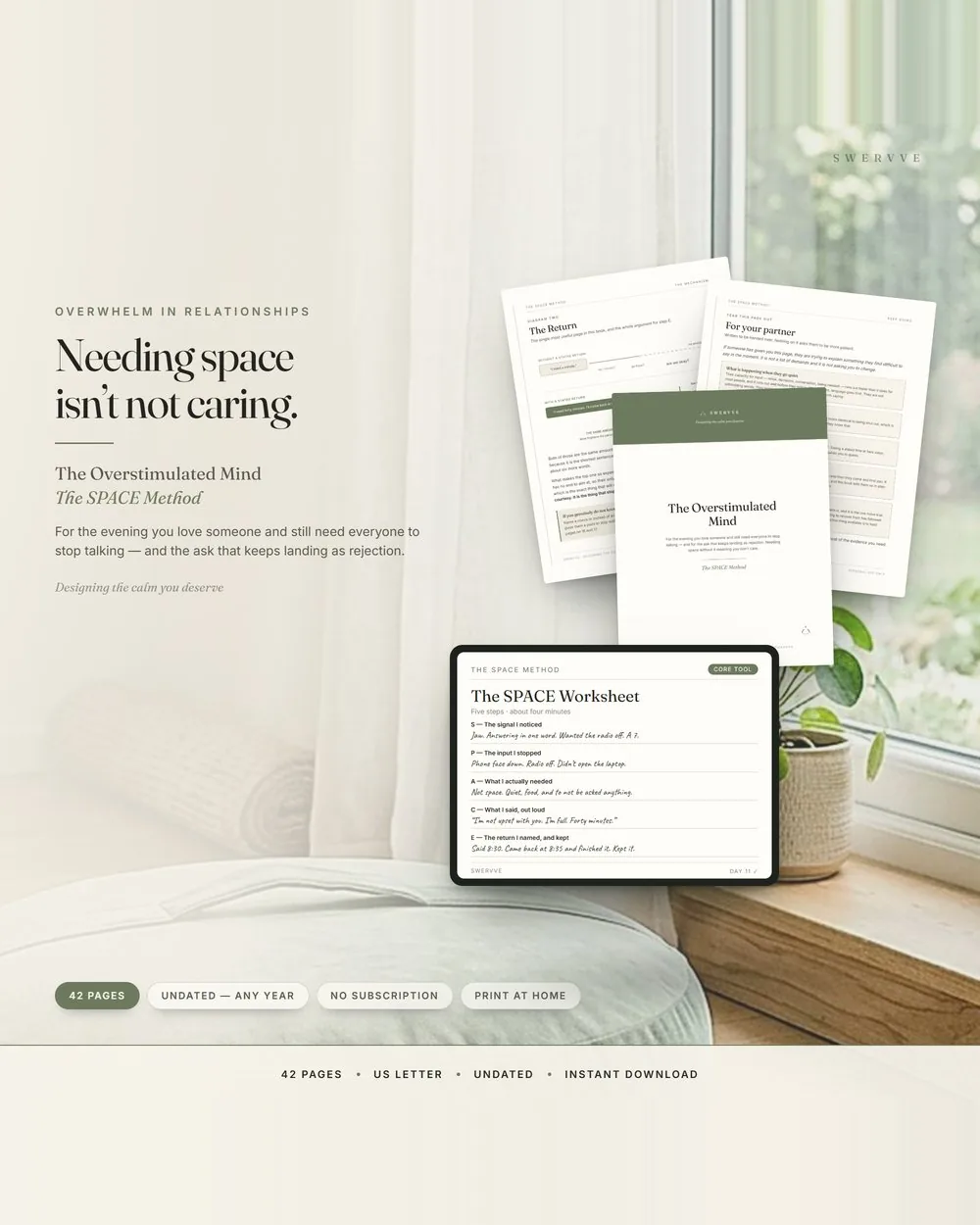
The Overstimulated Mind — The SPACE Method
A printable workbook built around the SPACE Method, for the hour when you love someone and still need everyone to stop talking. 42 pages — your own Overload Signal Map, the SPACE Worksheet plus six blanks, eleven scripts written out in full, an eight-week overwhelm tracker, and a tear-out page you can hand to your partner. Instant PDF download, and it works in GoodNotes too.
View the product
Why Anxious Attachment Feels Like an Emergency (And How to Anchor)
An unread text shouldn't trigger an adrenaline spike, but with anxious attachment, it does. Here is the neurobiology of relational panic — and how to anchor yourself before protesting.
The Window of Tolerance: How to Tell When You've Left It, and How to Widen It
There's a band of activation where you can think and feel at the same time. Outside it, coping strategies stop working. Here's how to spot the edges of yours, what to do in each direction, and how the window actually widens.

How to Set a Boundary Without the Guilt Spiral
People-pleasing isn't kindness — it's a fear response. Here's why the guilt after saying no is temporary, and a five-step method for holding a boundary and the relationship at the same time.