
Why Anxious Attachment Feels Like an Emergency (And How to Anchor)
You noticed the shift in their tone before anyone else in the room did. A one-word reply where there used to be warmth. A three-hour delay on a message they would normally answer in ten minutes. To someone with a secure attachment system, that's just a busy afternoon. To your nervous system, it feels like the floor just dropped out from under your life.
It isn't overreacting. It's an alarm system set too high
People with an anxious attachment style are frequently told they are "too sensitive," "needy," or "making a problem out of nothing." But relational neuroscience shows something very different: individuals with anxious attachment have a hyper-sensitised neuroception of danger. In childhood, emotional connection was often inconsistent — loving one minute, distant or unpredictable the next. To stay connected, your developing brain learned that vigilance was necessary for survival.
So when someone pulls back — even slightly, even innocently — your amygdala does not process it as scheduling friction. It registers an existential threat: disconnection equals abandonment. Your heart rate accelerates, your stomach tightens, cortisol floods your bloodstream, and a fierce compulsion arises: you must fix this right now.
Protest behavior: the panic that looks like an argument
When that alarm goes off, your brain scrambles to force connection back into place. Psychologists call these protest behaviours — actions designed to compel your partner to reassure you, even if the behaviour ironically pushes them further away:
- Frantic contacting — double-texting, calling repeatedly, or driving by just to "check in."
- Withdrawing to be chased — giving the cold shoulder or waiting hours to reply to see if they notice.
- Scorekeeping — tracking exactly who texted first, who said "I love you" more enthusiastically, or who apologised last.
- The long-paragraph text — sending a miniature essay explaining why their phrasing hurt, hoping for an immediate, detailed apology that resets your nervous system.
The problem is that protest behaviours never create real security. Even if they reply and apologise, the relief lasts maybe forty-five minutes — until the next delay or ambiguity restarts the cycle.
The twenty-minute pause: interception before escalation
The most important skill in overcoming anxious attachment is learning not to act while activated. When cortisol is flooding your prefrontal cortex, you cannot write a secure message. Every word you type will be an attempt to manage your internal panic rather than communicate your true feelings.
Give yourself a rule you can actually keep: set a timer for twenty minutes. When you feel that sudden sickening urgency to clarify, confront or plead, close the app and put the phone face down in another room until it goes off. Twenty is not arbitrary. Activation is a physiological event, and left alone it tends to peak somewhere around the fifteen-to-twenty-five-minute mark and then fall — without a reply, without reassurance, without anything being resolved. The goal is not to pretend you do not care. It is to move the message to the far side of that peak, where it will be written by a noticeably different person. And if twenty minutes is genuinely out of reach today, do five and write down five: a completed five beats a failed twenty by a wide margin, and the number climbs on its own within a fortnight.
Somatic regulation comes before cognitive reframing
You cannot talk a dysregulated nervous system out of panic using logic alone. Before you try to tell yourself "they're just working," you have to speak to your body in the only language it understands: somatic safety.
Try the physiological sigh: two quick inhales through the nose, followed by one long, slow, unforced exhale through the mouth. Repeat this three times. Place one warm palm flat against the center of your chest and feel the physical pressure against your sternum. This activates the vagus nerve and stimulates oxytocin release, signaling to your brainstem that you are physically safe right here, right now, in your own body.
Moving from Anxious to Earned Secure
Attachment styles are not life sentences. Attachment theory calls the transition earned security: the conscious process of developing internal trust, soothing your own activation, and learning to communicate needs plainly without shame.
Secure relationships are not built by finding someone who never triggers your anxiety; they are built by learning how to anchor yourself when the trigger arrives, and having clear, quiet scripts to express what you need without setting off an explosive conflict.
Where the workbook fits
Everything above can be started right now with a deep breath and a timer. What The Anxious Attachment Workbook adds is the concrete architecture for the moments when rational thought is not available:
It includes the complete ANCHOR Method sequence — one page per step — with a fully worked example and six blank worksheets to reprint. Alongside it: the Protest Behaviour Audit (nine behaviours named without shame, each with the move that replaces it), a base-rate page for what the silence usually actually turns out to mean, the Drafted-and-Deleted Page, seven word-for-word scripts for asking for reassurance without apologising for needing it and for naming distance with dignity, an eight-week Activation Trigger Tracker, and a cut-out pocket card for the spiral itself. Forty-four pages, printable, undated.
It is deliberately short. There are three-hundred-page workbooks in this category, and none of them are much use at minute four of a spiral. This one is built to be opened while it is happening and finished in about four minutes.
This is self-help material — CBT-informed and attachment-theory-informed, not therapy, not medical advice, and not a diagnosis. If you are in crisis, contact a crisis line now: 988 in the US and Canada, 116 123 in the UK and Ireland, or findahelpline.com. If a relationship is frightening you rather than activating you, that is a different problem — in the US, 1-800-799-7233; in the UK, 0808 2000 247.

The Anxious Attachment Workbook — The ANCHOR Method
A CBT- and attachment-theory-informed printable workbook built around the ANCHOR Method, for one specific moment: the twenty minutes after an unanswered text. 44 pages — the Protest Behaviour Audit, the ANCHOR Worksheet plus six blanks, seven communication scripts, an eight-week trigger tracker and a cut-out pocket card. Instant PDF download, and it works in GoodNotes too.
View the workbook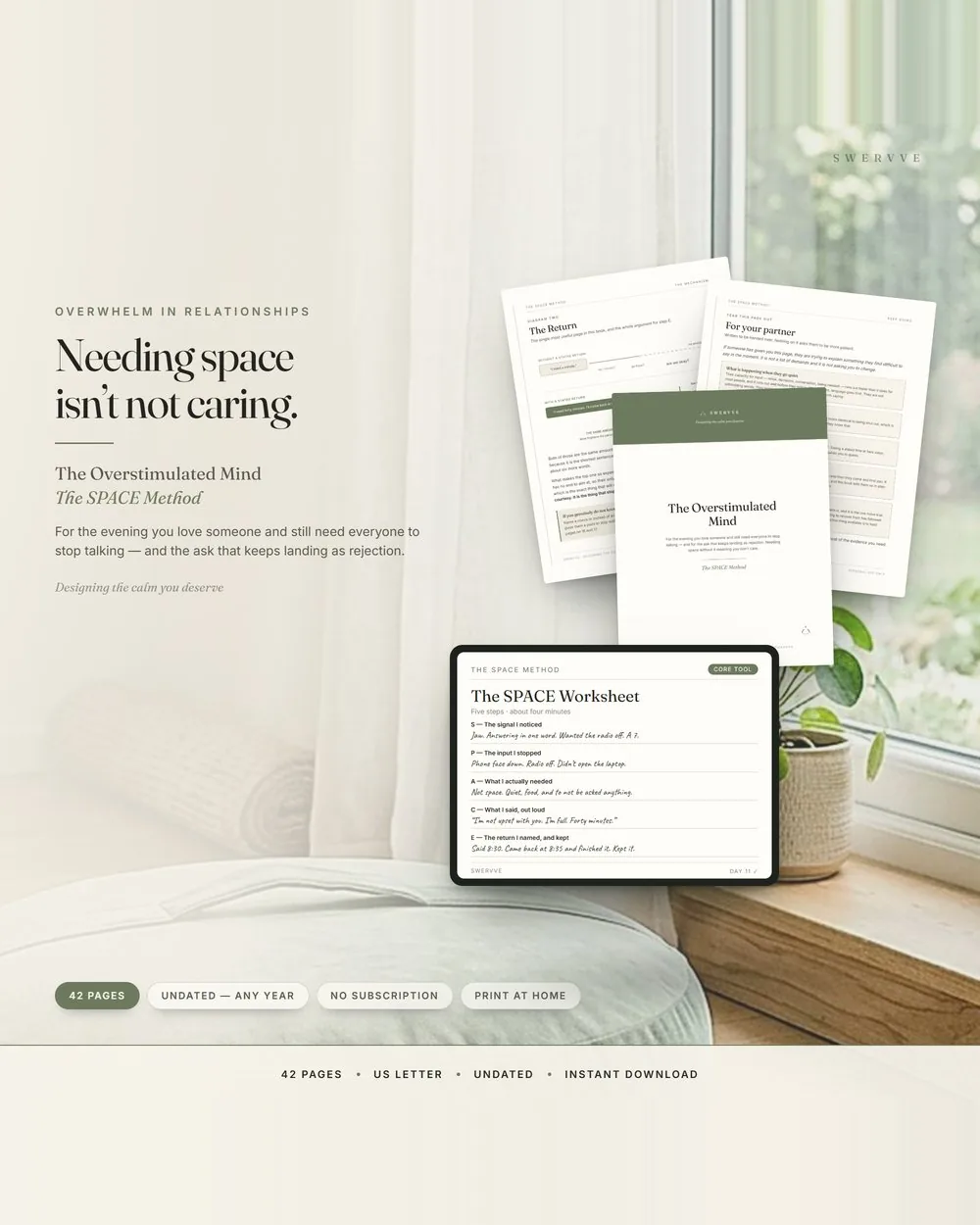
"I'm Not Mad, I'm Full" — Needing Space Without It Meaning You Don't Care
You love them and you still need everyone to stop talking. Here is why an ordinary question lands like a demand by seven o'clock — and the one thing that turns needing space from a fight into a non-event.

How to Set a Boundary Without the Guilt Spiral
People-pleasing isn't kindness — it's a fear response. Here's why the guilt after saying no is temporary, and a five-step method for holding a boundary and the relationship at the same time.

The Fawn Response: The Stress Reaction Nobody Talks About
Fight, flight and freeze get all the attention. Fawn — appeasing your way out of danger — is the one that looks like being nice, which is exactly why it's so hard to spot in yourself.