
The Fawn Response: The Stress Reaction Nobody Talks About
Most people can name three stress responses: fight, flight, freeze. There's a fourth that gets far less airtime, partly because it doesn't look like a stress response at all. It looks like being helpful. It looks like being easy to get along with. It looks, from the outside, like a good personality — which is exactly why it can run your life for twenty years without anyone flagging it, including you.
What fawning is
Fawning is appeasement as a survival strategy: managing a threat by making yourself agreeable to it. Rather than confronting, escaping or going still, you smooth things over. You agree. You apologise. You anticipate what the other person needs and hand it to them before they've asked, so that the tension never arrives.
The term was popularised by therapist Pete Walker, writing about the patterns people develop growing up around unpredictable or frightening adults. It isn't a formal diagnosis and it isn't in any diagnostic manual — it's a description, and a useful one, because it explains behaviour that "low self-esteem" and "conflict avoidance" never quite covered.
The core of it: if I can keep you comfortable, I am safe. That equation makes complete sense in an environment where someone's mood genuinely determined how your day went. It just doesn't switch off when you leave that environment.
What it actually looks like
Rarely dramatic. Usually:
- Agreeing before you've thought. The yes is out of your mouth while you're still working out whether you want to.
- Scanning the room. Constant, low-level monitoring of everyone's mood — who's gone quiet, whether that was a short reply, what it might mean.
- Pre-emptive apologising. Sorry for asking. Sorry for existing in the doorway. Sorry this message is long.
- Losing your opinion in real time. You had a view on the restaurant, the plan, the decision — and the moment someone else stated theirs with confidence, yours evaporated. Not suppressed. Genuinely gone.
- Managing other people's feelings about your own boundaries. You say no, and then spend two days doing emotional maintenance on the person you said it to.
- Feeling most yourself when you're useful. Being needed is comfortable. Being simply present, with nothing to offer, is not.
How it differs from ordinary people-pleasing
The distinction that matters isn't the behaviour — it's what sits underneath it.
Being kind, being accommodating, wanting people to have a good time: all of that can be a choice made from a settled place. You register the situation, decide their need outweighs your preference this once, and go along with it. You can tell it was a choice because you could have chosen otherwise, and the thought of choosing otherwise doesn't produce dread.
Fawning is not a choice. It's automatic, it happens ahead of thought, and it's driven by threat rather than warmth. Three practical tells:
- The timing. Genuine generosity arrives after you've registered the request. Fawning arrives before — the yes is already formed while the person is still finishing their sentence.
- The body. There's usually a physical spike: heat in the face, a held breath, a drop in the stomach, a need to resolve the moment immediately. Chosen kindness doesn't come with an alarm attached.
- The aftermath. Real generosity tends to feel fine afterwards, even when it cost you something. Fawning leaves residue — a slow resentment toward someone who, in fairness, only asked a question.
That last one is the most reliable diagnostic. Resentment towards people who have not actually done anything wrong is almost always the bill arriving for a yes that wasn't yours.
Why it's so hard to see in yourself
Four reasons, and they compound.
It gets rewarded. The accommodating person is well-liked, gets asked back, gets described as lovely to work with. No one intervenes on a pattern that's producing praise.
It works. Short term, it genuinely does what it's for: the tension dissolves, the room stays calm, the difficult person softens. A strategy that keeps succeeding is very hard to notice, let alone question.
You have no comparison. If it started early enough, you have no memory of a version of yourself who responds differently, so it doesn't feel like a response — it feels like your personality. People often only catch it by watching someone else decline something easily and thinking: you're allowed to do that?
It doesn't feel like fear. This is the big one. Fight feels angry. Flight feels panicky. Fawn mostly feels like being busy, or being thoughtful, or being the responsible one. The fear is doing all the work underneath a surface that reads as competence, so the internal evidence you'd normally use — "am I frightened right now?" — comes back negative.
What it costs
The obvious cost is time and energy spent on other people's priorities. The less obvious one is more expensive: you stop knowing what you want.
Preferences need practice. If every small decision has been outsourced to whoever in the room seems most certain, the question "what do I actually want here?" stops returning an answer. People describe this as feeling vague or shapeless — fine with anything, no strong feelings, easy. It isn't easiness. It's a skill that atrophied from disuse.
The second cost is in the relationships themselves. If people have only ever met the accommodating version of you, then the closeness you have is with that version. It's why long-term fawning so often comes with loneliness inside relationships that look, on paper, perfectly good.
Where to start
You do not start by having a confrontation. You start by restoring the gap between the request and your answer, because that gap is where all your choices live.
- Buy time by default. "Let me check and come back to you" is a complete sentence, and it works for almost everything. Use it even when you're fairly sure the answer is yes — the point is to practise the pause, not to stall.
- Check the body first, not the logic. Before you answer, notice: held breath, hot face, tight stomach? That's an alarm firing, which is useful information about what's driving the yes.
- Ask the question that has gone missing. "What do I want here?" Expect a blank at first. Ask it anyway, and on small things — coffee, film, weekend — where the stakes are low enough that an answer can form.
- Practise on the safest people, not the hardest. The instinct is to test this on the person who triggers it most. That's the last rep, not the first. Start with a friend who will simply say "sure, no problem."
- Let the guilt happen without acting on it. A boundary from a fawn pattern will produce a guilt spike. It's an old rule firing, not evidence of harm. Guilt you don't feed fades, usually faster than expected — and every time it does, the alarm gets a little quieter.
The awkward middle
Worth knowing in advance: some people will not enjoy this. Anyone who benefited from your unreserved yes may push back the first few times, and it will feel like proof you've done something wrong. Mostly it's proof the pattern was real. Relationships that were built on it may get briefly bumpy; the ones worth keeping settle into something more honest, and you'll notice you enjoy those people more once you're not performing for them.
A note on scope
Recognising a fawn pattern is self-knowledge, not treatment. If yours traces back to trauma, abuse, or a childhood that still feels heavy to think about, that deserves proper support — a licensed therapist, ideally one who works with trauma. Reading about it is a starting point, not a substitute. If you're in crisis, in the US and Canada you can call or text 988; in the UK and Ireland, Samaritans is free on 116 123, any time.
Where the workbook fits
The five steps above are the whole practice, and they cost nothing. What the printable version adds is the reps: a one-page method for the moment someone asks, a bank of scripts for the requests that are hardest to decline, a resentment audit that shows you where your missing boundaries actually are, and a guilt timeline so you can watch the feeling fade in real time instead of taking its word for it.

The People-Pleaser's Boundary Workbook
A calm, CBT-informed 40-page printable workbook built around the WORTH Method — for the moment someone asks, so you stop over-apologising and saying yes when you mean no. Includes a script bank, a resentment audit, and a guilt timeline.
View the workbook
Why Anxious Attachment Feels Like an Emergency (And How to Anchor)
An unread text shouldn't trigger an adrenaline spike, but with anxious attachment, it does. Here is the neurobiology of relational panic — and how to anchor yourself before protesting.
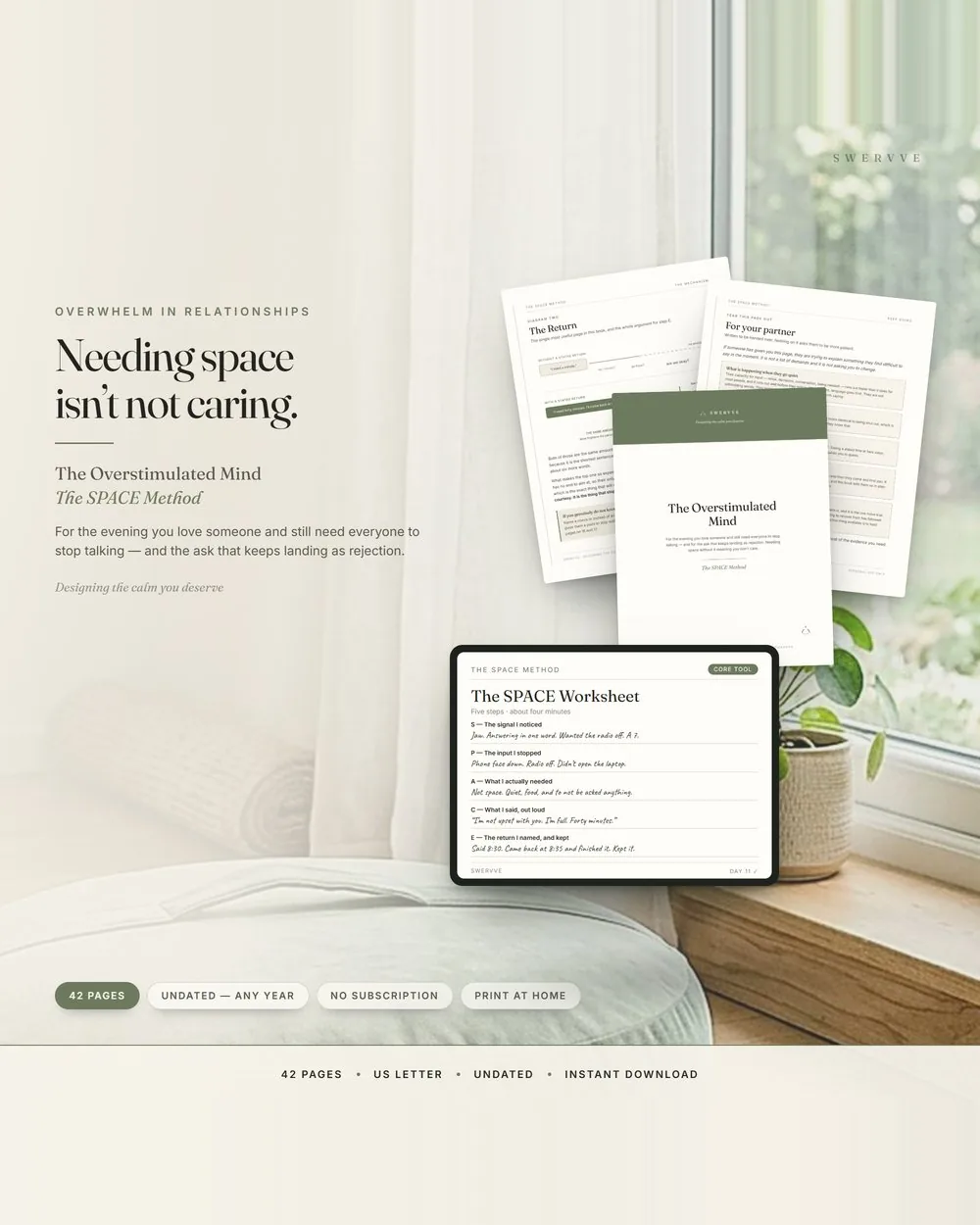
"I'm Not Mad, I'm Full" — Needing Space Without It Meaning You Don't Care
You love them and you still need everyone to stop talking. Here is why an ordinary question lands like a demand by seven o'clock — and the one thing that turns needing space from a fight into a non-event.

How to Set a Boundary Without the Guilt Spiral
People-pleasing isn't kindness — it's a fear response. Here's why the guilt after saying no is temporary, and a five-step method for holding a boundary and the relationship at the same time.